If VinFast and Wolfspeed are about to flood Lee County with thousands of new manufacturing jobs, why did Sanford homes sell for less this June than they did a year earlier?
That's the question a lot of buyers and investors aren't asking, because the version of Sanford they've encountered online is the boom version: billions in announced investment, a "Brick Capital of the USA" turned industrial corridor, farming campaigns built around phrases like "emerging seller's market." Meanwhile, the actual closed-sale data tells a quieter story. Sanford's median home sale price sat at $307,822 in June 2026, down 2.3 percent from the year before. In January 2026, it was $298,000, down 5.5 percent year over year. Homes have been taking around 95 days to sell. That's not the signature of a market bracing for an employment surge. It's a market where supply is outrunning demand, and the reason has nothing to do with whether the megasite story is true. It has to do with timing.
What the megasite story actually promised
The pitch has real substance behind it, which is exactly why it's easy to believe on faith alone. In 2022, Governor Roy Cooper announced that Vietnamese EV manufacturer VinFast had chosen the Moncure megasite in Chatham County, now branded Triangle Innovation Point, for its first North American production facility: at least $4 billion in investment and at least 7,500 jobs, occupying more than 2,000 acres about 25 miles from Sanford. Around the same time, Durham-based Wolfspeed broke ground on a $5 billion silicon carbide materials plant in Siler City, promising 1,800 jobs at what the company called the world's largest facility of its kind. Add in Toyota's $13.9 billion battery plant 35 miles northwest in Liberty, and you get the regional case for Sanford as the affordable bedroom community sitting in the blast radius of a manufacturing boom.
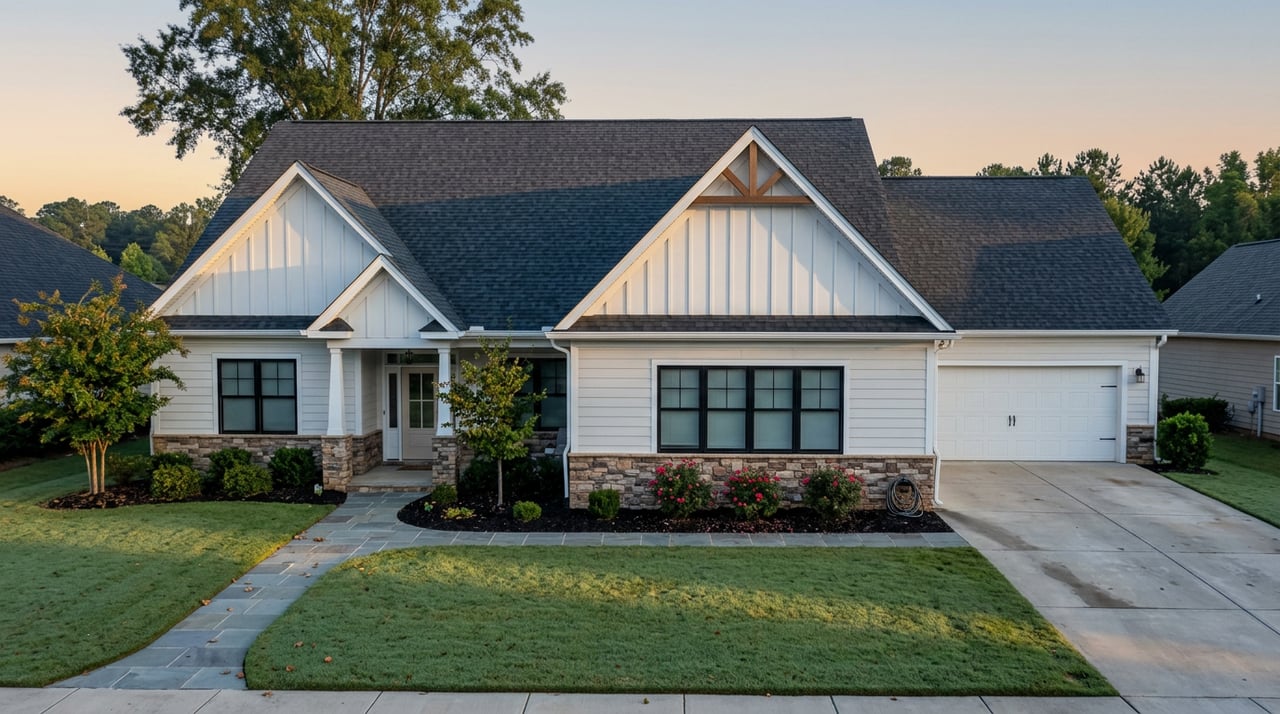
That case is why Lee County has seen a wave of new master-planned development. Centerpoint Investments is building out Ashby Village, a 140-acre mixed-use project that will eventually include more than 700 residential units, with CBRE separately marketing a 32-acre commercial parcel for retail, restaurants, and medical office space. The project sits next to the 130-acre Lee County Athletic Park, expected home of the Sanford Spinners minor league baseball team. A few miles away, Lennar's Marelli community is selling new single-family homes within walking distance of Main Street. Builders read the same announcements everyone else did, and they built accordingly.
Where the timeline actually broke
Here's what the boosterish content doesn't mention: both anchor projects have missed their own deadlines by years, not months.
VinFast's contract with the state included a January 1, 2024 deadline to start vertical construction and a July 1, 2026 benchmark to begin producing parts and cars. Neither happened. According to a lawsuit the North Carolina Attorney General's office filed this spring, the Moncure site has been largely abandoned since the end of 2024. The company hasn't held a construction contract since that year, and its building and environmental permits expired without renewal. VinFast executives told state officials as recently as March 2026 that they were about to resume construction, but the state's complaint says they proposed scaling the project back to a distribution center rather than the car factory they'd contracted to build. Governor Josh Stein didn't mince words about it: "VinFast Manufacturing simply did not honor its commitments or meet previously agreed upon benchmarks." VinFast's own securities filing, released alongside its 2025 earnings in March 2026, confirms the company now expects to resume construction sometime in 2026 with a production start in 2028, four years past the original target.
Wolfspeed's path has been different but no less rocky. The company filed for Chapter 11 bankruptcy on June 30, 2025, and emerged just 91 days later, on September 29, 2025, having eliminated $4.6 billion in debt and cut its annual interest expense by roughly 60 percent. That sounds like a recovery story, and financially it is one. But the Siler City site cut 73 jobs that same June, citing softer demand for some of its chip products, even while insisting the facility "remains on track to open in the near future." Its most recent earnings, reported in February 2026 for fiscal Q2 2026, missed both revenue and profit forecasts: $168 million in revenue, down 6.9 percent year over year, and a negative gross margin of 46 percent. The company is now betting heavily on AI data center demand rather than the EV market that originally justified the Siler City investment, and that pivot is still in progress.
None of this means the projects are dead. VinFast has stated a 2028 production target, and Wolfspeed's Siler City plant is still described as central to its long-term strategy. But if you're pricing a home purchase, or a listing, around jobs landing in "2026-2027," as some market content still claims, you're pricing against a timeline that no longer exists.
What that gap does to the actual market
This is the part the headline stats explain once you know where to look. Sanford's housing supply kept growing on the strength of a 2022-era promise. New subdivisions like Marelli and the residential phase of Ashby Village were planned and permitted when 2024 and 2025 still looked like realistic hiring windows. That inventory is now hitting the market at the same time the jobs that were supposed to absorb it have slipped years out. More listings chasing a buyer pool that hasn't grown as fast as expected is a textbook recipe for softening prices and longer days on market, which is exactly what the numbers show.
For a buyer, this is useful information, not a warning to stay away. A market with 95 days on market and a falling median gives you room to negotiate that didn't exist when the boom narrative was driving multiple-offer situations. For a seller, it means pricing has to reflect what's actually closing in Lee County right now, not what a farming campaign says the market "should" be doing based on projects that haven't broken ground. For an investor weighing Sanford against other Triangle-periphery towns, the real question isn't whether VinFast and Wolfspeed matter. It's whether your hold period comfortably reaches past 2028, because that's the earliest either anchor project is now expected to be running at scale.
What this doesn't change
The fundamentals that made Sanford attractive before the megasite headlines are still there. It's still roughly 30 to 40 miles from Raleigh with direct access via US Highway 1 and US Highway 421. Downtown still has its own draw, from the Temple Theatre to the Railroad House Museum to a growing lineup of locally owned restaurants and shops. Central Carolina Community College still anchors a stable local workforce independent of any single manufacturer's timeline. The billions in announced capital haven't evaporated, they've just moved further down the calendar than the marketing suggested.
Frequently asked questions
Is Sanford's housing market in trouble? No. A median price decline of a few percent alongside 90-plus day sale times describes a market that's rebalancing toward buyers, not one in distress. It's a meaningful shift from the tight, fast-moving conditions the megasite narrative implied, but it's a normal market correction, not a warning sign.
Should I wait for VinFast or Wolfspeed to actually start hiring before buying in Sanford? That depends entirely on your own timeline and goals, and it's worth working through with someone who tracks both the state filings and the local closed-sale data, since the two tell different parts of the same story.
Does the delay affect Ashby Village and Marelli? Not directly. Those are private residential and mixed-use developments moving forward on their own schedules. The connection to VinFast and Wolfspeed is about regional demand assumptions, not about whether those specific projects will be built.
If you're trying to figure out what the megasite timeline actually means for a specific move, whether you're buying in Lee County, selling into a market that's cooler than the headlines suggest, or comparing Sanford against other Triangle towns, Rachel Greenwood and the Greenwood Collective team track both the state filings and the closed-sale data so you don't have to choose between them. Get your free home valuation and a straight read on where Sanford's market actually stands today.